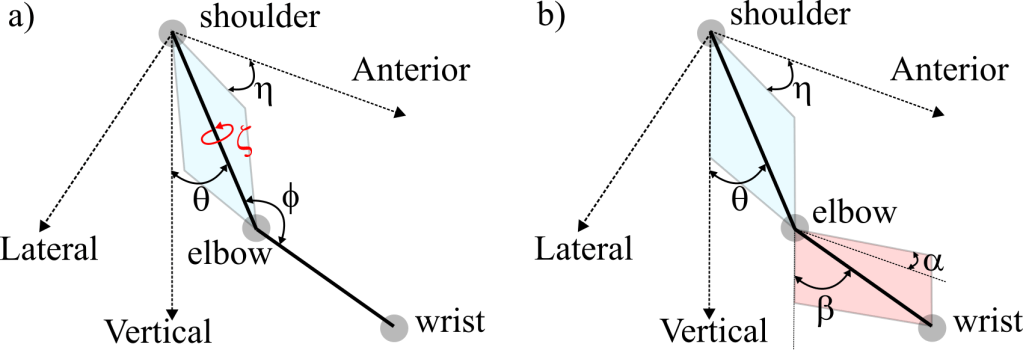
We present an approach to solving the inverse kinematics problem based on spatio-temporal basis functions, and show that there may be preference for an absolute reference frame in neural control of movement.

We present an approach to solving the inverse kinematics problem based on spatio-temporal basis functions, and show that there may be preference for an absolute reference frame in neural control of movement.

We showed that intersegmental covariation is affected by transfemoral amputation asymmetrically, and assessed how this is differently affected for amputees with different mobility levels and walking on various semi-passive prosthetic legs.

We compared the performance of forward prediction systems for powered prostheses combining kinematics, kinetics, EMG, and vision while tested on a transfemoral amputee walking on a powered knee-ankle prosthesis.

In this paper, we summarize the recent and ongoing published work in the promising new area of research of incorporating teleception into control and intent recognition for robotic assistive devices.

We propose a novel controller for powered prosthetic arms, in which EMG and gaze data are used to predict the end-point for a full arm prosthesis, which could then be used to drive the forward motion of individual joints.

We presented a device-agnostic, feature-driven approach and analysis of the variability within and between subjects and activities for each sensor modality for control and prediction of desired activity for powered prosthetic legs or exoskeletons.

We presented a proof of concept for a novel approach to bilateral gait segmentation using a thigh-mounted inertial measurement unit (IMU) and depth sensor with the contralateral leg in its field of view.

We developed an algorithm to segment stairs from depth sensing of the environment and extract significant measures to detect the user intention, such as the distance and angle from the stairs, the number of steps, stair height, and stair depth. We conducted several experiments to test the our system and achieved 98.8% accuracy.

I developed a six degree-of-freedom prosthetic hand to be inexpensive and open source. The hand design was shared on http://www.opensourcehand.wordpress.com